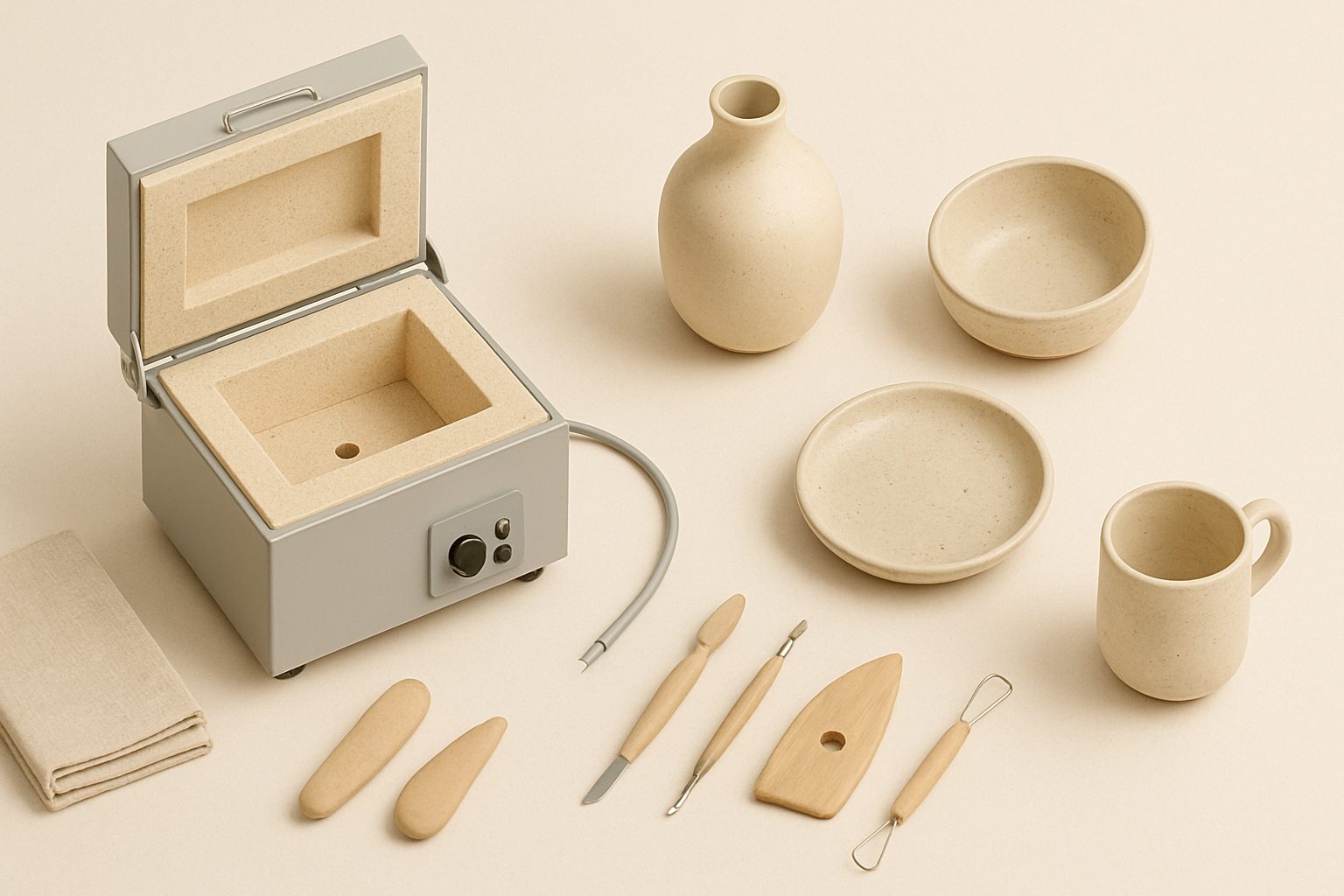
Front-Loading vs Top-Loading Kilns for Home Use UK – Which Is Right for You?
If you're setting up a ceramic studio at home, choosing between a front-loading (chamber) kiln and a top-loading (updraft) kiln is one of the earliest and most important decisions you'll make. Both designs are common in the UK hobby market, but they excel in different situations. Understanding their practical differences will help you pick the right fit for your space, budget, and working style.
The Basic Difference
Front-loading kilns have a door on the front that swings open horizontally, giving you access to a deep chamber. Top-loading kilns have an opening at the top where you load pieces into a vertical shaft. This single difference cascades into everything else: how you work, how much space you need, how much heat escapes, and how much you'll spend on electricity.
Ergonomics and Ease of Loading
Front-loading kilns win on comfort. You can load pieces at waist height, which means no bending, no awkward reaching, and minimal risk of dropping expensive work into a hot kiln. If you're doing regular firing cycles or have mobility considerations, this matters. The kiln is also easier to inspect and adjust during the loading process.
Top-loading kilns require you to stack pieces inside a narrow vertical chamber. This means bending or standing on a stool, and careful stacking to avoid pieces toppling. It's manageable for small batches, but for a busy studio—especially if you're throwing regularly—it becomes tedious. Reaching deep into a top-loader to place pieces at the bottom is genuinely awkward, and there's a higher risk of accidental damage to ware or kiln furniture.
For potters who are older, pregnant, or have back problems, front-loaders are significantly more comfortable to use regularly.
Heat Loss and Efficiency
Top-loading kilns lose more heat through the open top during loading and unloading. This means they use more energy to reach and maintain temperature. Front-loaders seal better when the door closes, so they're noticeably more efficient. In a UK home studio where electricity costs are climbing, a front-loader will cost less to run over time.
The difference is real enough that heavy users notice it on their power bills. If you're firing once or twice a month casually, it won't transform your costs. If you're firing weekly, efficiency matters.
Space Requirements
Top-loading kilns are narrower and fit into tight corners—useful if you're working in a small spare room or workshop. They also need less clearance in front of them because you're not swinging a door open.
Front-loaders need floor space for the door swing, plus some working room in front for loading and unloading pieces. If your studio is very compact, or if you're planning to squeeze the kiln against a wall, a top-loader might be your only option. Most UK home potters have enough space once they commit a corner to the kiln, but it's worth measuring your actual setup.
Cost and Availability
Top-loading kilns are generally cheaper to buy upfront—sometimes £500–£1,500 less for comparable firing capacity. This is a real advantage if budget is tight at the start. They're also lighter, which matters if you're renting and need portability.
Front-loaders cost more initially but often have lower running costs and better resale value, especially at serious size (20+ cubic feet). Small tabletop front-loaders have narrowed the gap, though prices still skew upward. UK suppliers stock both types readily, so availability isn't a practical constraint anymore.
Firing Capacity and Flexibility
Top-loaders can feel cramped when you're trying to arrange a large batch of work. The narrow vertical shaft forces you to stack in a specific way, and large or awkwardly shaped pieces are difficult to fit.
Front-loaders give you a wider, shallower space that's easier to load efficiently. You can stand more pieces upright or sideways, and you have more flexibility with kiln furniture placement. For sculptural work or larger thrown forms, this flexibility is valuable.
Maintenance and Repair
Front-loaders have a mechanical door system with hinges, latch, and occasionally a safety catch. These need occasional adjustment but are straightforward to maintain. Top-loaders have fewer moving parts, which is simpler in theory. However, when things do go wrong—a hinge crack, a latch failure—a front-loader repair is usually cheaper and faster locally.
Which Should You Choose?
Choose a front-loader if you're firing regularly, have back or mobility concerns, want lower running costs, or value the easier loading process. They're the more forgiving choice for most home studios and tend to reward you for using them frequently.
Choose a top-loader if space is genuinely tight, budget is the limiting factor at startup, and you're planning only occasional firings. They work perfectly well for part-time or casual potters; the inefficiency and ergonomic awkwardness only become frustrating if you're in the studio constantly.
Next Steps
Once you've settled on a loading style, the next layer of comparison—size, brick type, element configuration—becomes much clearer. Look for detailed reviews of specific models in your chosen style. UK pottery forums and local studio groups are reliable sources; they'll tell you which brands hold up well in damp British workshops and which have disappointed after a few seasons.
More options
- Electric Ceramic Kilns – Full Range (Amazon UK)
- Programmable Kiln Controllers (Amazon UK)
- Kiln Furniture & Shelves (Amazon UK)
- Kiln Vent & Fume Extraction Systems (Amazon UK)
- Jewellery & Small Specialty Kilns (Amazon UK)