Best Small Kilns for a Home Studio UK – Compact Picks for 2025
If you're setting up a ceramic studio in a garage, spare room, or workshop, kiln size matters more than you might think. A compact kiln lets you work at home without commandeering an entire building, but squeeze too tight and you'll struggle with batch sizes or limited artistic scope. This guide covers sub-40-litre kilns that actually fit UK homes and unpacks what "small" really means when your electrics and space are constrained.
Why sub-40 litres makes sense for home potters
A 40-litre kiln holds roughly 20–25 hand-sized pots per firing, or 15–20 larger pieces, depending on how you load it. That's realistic for home practice, hobbyist production, or small commissions. Larger models (50–60 litres) offer more per batch but demand serious floor space, stronger electrics, and climate control.
Firing costs matter too. A 40-litre electric kiln to cone 6 costs roughly £2–£3 in electricity per firing with current UK rates, making daily practice affordable. Anything significantly larger tips toward production-kiln running costs and heat load that domestic buildings struggle with.
UK electrical reality: the limiting factor
This is where most home studios hit a wall. Standard UK homes run on either a 63A or 100A supply, split between lighting, heating, and appliances. Most compact electric kilns demand either a dedicated 13A plug socket (fine for very small models under 1.5 kW) or a hardwired 32A circuit (the next step up for 6–10 kW kilns).
Before buying, check your fusebox and ask an electrician whether you can run a 32A ring or dedicated circuit to your studio. Some kilns claim 13A compatibility but heat slowly; others require 32A and demand installation. It's not negotiable—undersizing the circuit risks fires or repeated circuit breaker trips.
Chamber depth: the hidden constraint
Kiln height and depth both matter, but depth is what catches people out. A kiln with a 35-litre chamber might be 60 cm tall but only 45 cm deep—fine. Another 35-litre model might be deeper and narrower. If your workspace is against a wall or next to shelving, a deep-and-narrow kiln becomes useless because you can't load it or reach the back.
Measure your space first, accounting for door swing and access on at least two sides. A kiln shoved into a corner, with its door blocked by clutter, won't get used.
Small kilns worth considering
Compact tabletop models (under 20 litres, 13A plug-in)
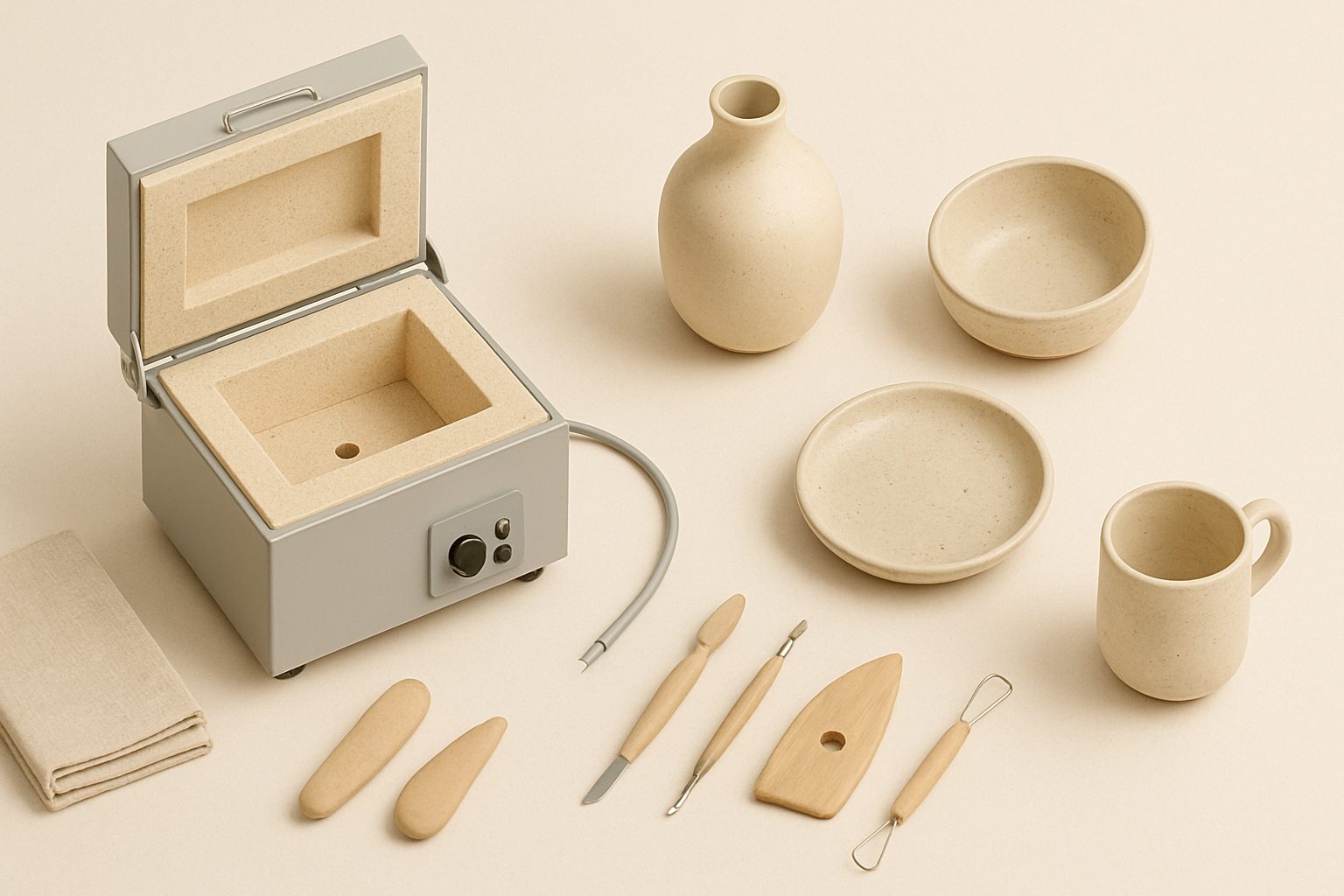
These are genuinely small—think of a lidded box roughly 35 cm wide and 30 cm deep. They're excellent for testing glazes, small sculptural work, or learning. But they fire slowly (cone 6 in 10–12 hours rather than 6–8) because wattage is limited to avoid overloading a standard socket. If you're planning regular production work, tabletop models feel cramped quickly.
Mid-range front-loaders (25–35 litres, 32A)
This is the sweet spot for most home studios. A 32-litre kiln holds enough work to stay motivated but fits in a spare room or corner garage setup. Chamber sizes vary widely: some are tall and narrow, others squat and square. Firing time is 6–8 hours to cone 6, and electricity per firing is manageable.
Check the amp draw carefully. Some 30-litre kilns run at 6 kW (26A at 240V, safe for a 32A circuit), whilst others demand 7.5 or 9 kW. That 9 kW model won't work on a standard domestic 32A circuit—you'd need a 40A+ supply, which most homes don't have without upgrade costs.
Compact top-loaders (25–40 litres, 32A)
Top-loading kilns are deeper and narrower than front-loaders, which can be an advantage if your space is against a wall. They're stable, take up less floor footprint, and the arch of the kiln (less likely to warp at the top) suits them. The downside: loading tall pots is awkward, and if you reach into a small aperture, you risk scalding your forearm on the rim during high-temperature firings.
Ventilation and heat—realistic expectations
A 40-litre kiln radiates significant heat. Room temperature in a small studio can rise 5–10°C during a full firing, especially in summer. That's uncomfortable and bad for pot stability if the kiln environment fluctuates wildly. Crack a door or window, use a small extract fan, or accept that summer firings need timing.
Downdraft venting (ducting kiln fumes out of the building) is ideal but rarely essential for stoneware or earthenware. Glazes containing cobalt, chrome, or heavy metals warrant ventilation; most standard glazes don't. Check your specific glazes.
Making the choice
Start with a realistic firing schedule. If you're a hobbyist firing once a week, a 25–30-litre kiln is plenty and keeps costs low. If you're running a small business or teaching, step up to 35–40 litres, but cost the 32A installation first—it's often £300–£600.
Measure your space ruthlessly. Measure twice, measure again. A kiln that doesn't fit your room stays a beautiful dream in a supplier's catalogue.
Finally, talk to existing users. Kilns vary in thermostat reliability, element longevity, and whether replacement parts are readily available in the UK. An obscure import might be cheaper upfront but stranded when an element fails and spares take three months to arrive from abroad.
The best small kiln is the one you'll actually use—compact enough to fit your home, powerful enough for your work, and wired safely to your electrics.
More options
- Electric Ceramic Kilns – Full Range (Amazon UK)
- Programmable Kiln Controllers (Amazon UK)
- Kiln Furniture & Shelves (Amazon UK)
- Kiln Vent & Fume Extraction Systems (Amazon UK)
- Jewellery & Small Specialty Kilns (Amazon UK)